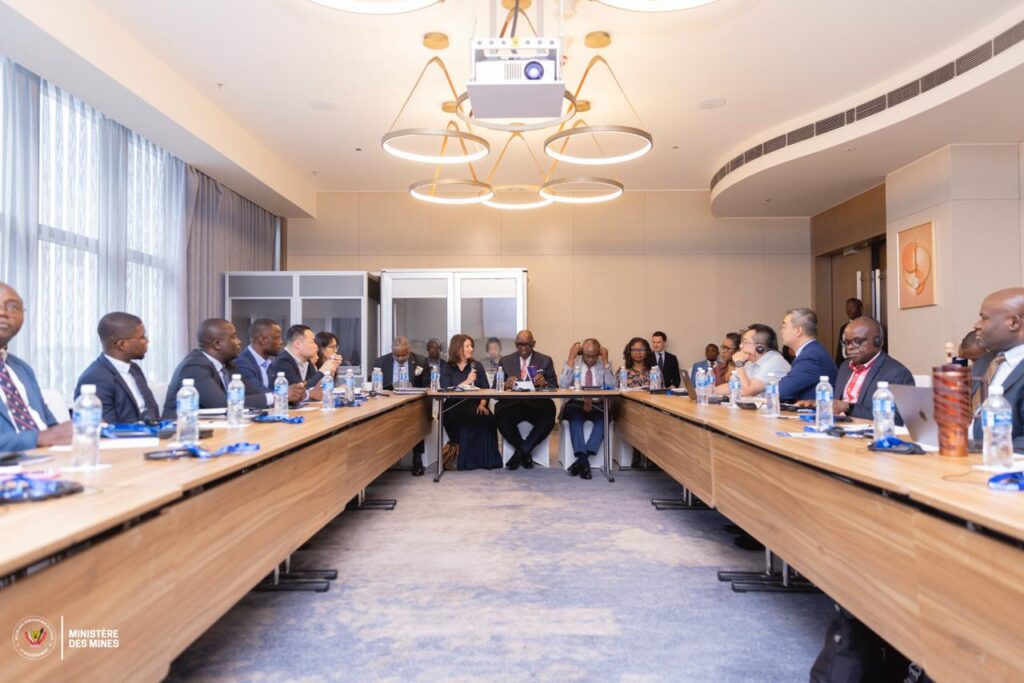
Strengthening ESG for a Competitive Cobalt Future: Cobalt Institute Hosts Workshop in Kinshasa
By Susannah McLaren, Head of Responsible Sourcing & Sustainability, Cobalt Institute
Cobalt Institute, in partnership with the Chamber of Mines of DR Congo and the Union des Sociétés Minières aux Capitaux Chinois of DR Congo (USMCC), convened a high-level workshop in Kinshasa to support the Congolese cobalt sector in meeting rapidly evolving environmental, social and governance (ESG) expectations.
Opening Highlights
H.E. Louis Watum Kamamba, Minister of Mines of the Democratic Republic of the Congo (DRC), was welcomed to the workshop by Cobalt Institute Director General Dinah McLeod. He then delivered a keynote speech underscoring the strategic importance of ESG in maintaining global competitiveness and commended the partners for uniting the industry around shared challenges.
“Societal, environmental and industrial practices are no longer optional - these are market obligations and prerequisites for competitiveness.”
— H.E. Louis Watum Kamamba, Minister of Mines
🆕 Spotlight: Government Announces Plans for a National ESG Prize
During his speech, the Minister shared that the Ministry of Mines is examining the creation of a National Environmental and Social Governance Prize. He highlighted that this “positive sanction” approach aims to encourage excellence, reinforcing the DRC’s ambition to position itself as a responsible, reliable, and forward-looking mining investment destination.
This initiative was welcomed by participants as a meaningful step toward raising ESG ambition across the sector and celebrating operators who demonstrate leadership.
Understanding Global ESG Expectations
Susannah McLaren, Head of Responsible Sourcing & Sustainability at the Cobalt Institute, provided a comprehensive overview of the global regulatory landscape shaping the cobalt value chain. She highlighted the accelerating impact of the EU Batteries Regulation, the expansion of import bans, and China’s Corporate Sustainability Disclosure Standards.
“Improved ESG performance is not only a regulatory necessity – it is a competitive advantage for DRC producers and a meaningful way to ensure that the benefits of responsible cobalt production are shared with the people of Congo.”
— Susannah McLaren, Cobalt Institute
Downstream Buyer Expectations
Franziska Killiches of Volkswagen Group emphasized the company’s commitment to sustainability. She outlined the growing expectations placed on global automotive manufacturers, highlighting that compliance with emerging regulations – especially the EU Batteries Regulation – is now a decisive factor for market access.
“Downstream buyers increasingly depend on deep supply chain transparency, robust due diligence, and credible ESG practices. By implementing recognised sustainability standards and tools, such as those accepted by the Volkswagen Group – including IRMA as well as the Responsible Mineral Initiative’s RMAP+ and ESG Facility Standard – suppliers play a crucial role in ensuring responsible cobalt sourcing and meeting the requirements of the EU Batteries Regulation.”
— Franziska Killiches, Volkswagen Group
Building Trust Through Third-Party Certification
In 2024, 77% of global cobalt mined supply was subject to ‘RMI RMAP-conformant’ due diligence by refineries[1], with 83% of this assessed material originating from assets located in the DRC.[2]
A key theme reinforced during the workshop was that third-party sustainability certification is one of the most effective ways to build trust with international stakeholders. These figures demonstrate that DRC-produced cobalt is among the most independently verified in the world, strengthening confidence among downstream users and supporting continued market access.
CMOC Group Limited shared an overview of its ESG approach in the DRC, highlighting the company’s commitment to responsible mining across its two flagship operations, TFM and KFM. CMOC emphasised that both sites undergo annual Responsible Minerals Assurance Process (RMAP) assessments to ensure alignment with OECD due diligence requirements, and noted that TFM is the first mine in Africa to be awarded the Copper Mark certificate. CMOC underscored that these efforts demonstrate that robust ESG performance is central to its identity as a modern, world-class mining company.
Glencore shared its experience with ESG implementation and third-party assurance at its two operations in the DRC, KCC and Mutanda. This began with the RMAP five years ago and the Copper Mark most recently. The company emphasised how independent assessments have strengthened transparency, risk management, and continuous improvement. For example, updated versions of the RMAP have been implemented over the years and the Copper Mark assessment was completed with the significantly expanded latest version (3.0).
Together, the contributions from Glencore and CMOC illustrated how large-scale operators are already taking concrete, independently verified steps to meet global ESG expectations, build trust and support responsible cobalt production in the DRC.
Practical Guidance: Responsible Contractor Management
Josephine Dadzie, Senior Regional Lead for Africa at Verité, shared tools and practices to strengthen labour rights and subcontractor oversight, including ethical recruitment, forced-labour risk identification, grievance mechanisms and third-party monitoring.
“It is important to tailor human rights due diligence work to suit local contexts and laws, while maintaining international and industry standards. When it comes to understanding indicators of labour violations for instance, the risks must be matched with local realities. For example, a metal bar in a window could mean security protection in one jurisdiction, while in another, it may mean workers are being prevented from moving about freely.”
— Josephine Dadzie, Verité
Closing Reflections
“The world looks to the DRC as the backbone of the energy transition.”
— Dinah McLeod, Cobalt Institute
Dinah McLeod closed the workshop by emphasising the DRC’s central role in global energy and digital supply chains and reaffirming CI’s commitment to supporting safe, sustainable and responsible cobalt production.
For more information, visit www.cobaltinstitute.org
[1] Although the RMI assessment applies to refiners, all the cobalt sourced, including mined material, is subject to due diligence by these refiners which is verified in the scope of the RMI evaluation. Through detailed understanding of the supply chain, Benchmark has been able to quantify the amount of mined cobalt that falls within the scope of the assessment.
[2] Benchmark Mineral Intelligence | Rho Motion 2025